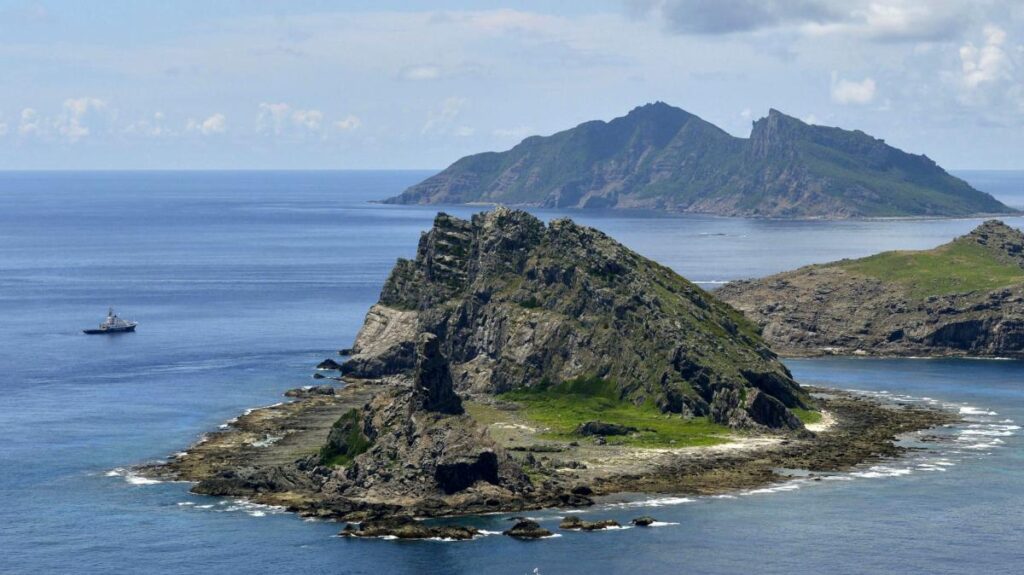
A massive, but flawed Fukushima/Tohoku response, the Senkaku islands confrontation with China, proposed amendments to Japan’s post-war Constitution regarding its defense capabilities, developments in relations with other regional militaries, the successful “Dawn Blitz” joint amphibious landing at Camp Pendleton with U.S. Marines, and then the Abe/Yasukuni visit…. what is actually happening on Japan’s military side that many are missing?
This program is about a new Japanese military with new, enhanced capabilities that have been achieved with remarkable speed over the past 18 months.
This week, Grant Newsham (formerly, Col. USMC), a Senior Research Fellow at the Japan Forum for Strategic Studies in Tokyo and formerly the U.S. Marine liaison officer with the Japan Self Defense Forces joins “Asia in Review” Host David Day for a fascinating discussion on this topic.
Mr. Newsham is also a former diplomat with the U.S. Embassy in Tokyo and formerly a Director of a major Tokyo financial firm.
So what are China’s next strategy moves in the Asia-Pacific Region? What does the PLA really think about the U.S. military and its capabilities? –a bizarre perception that encourages them to push harder now.
China has now been successful at establishing its Air Defense Identification Zone (ADIZ) in the South China Sea. In the process, we have seen a bizarre, almost schizophrenic, series of contradictory communications on the subject coming out of Washington that have enhanced China’s successful roll-out.
Following the roll-out, China’s lone aircraft carrier (sans aircraft) departed for the South China Sea for a “show the flag” cruise. Next, we witnessed a near collision by U.S. and Chinese naval ships in the South China Sea.
This program is Part 2 of the conversation between David Day and China-Hand Michael Sacharski. Mr. Sacharski has spent some 3+ decades in China, met and worked with various members of its leadership and has fascinating perspectives to share about China’s ADIZ planning & gameplan, its unexpected success in the imposition of its new ADIZ in the East China Sea, and what strategic moves we can now expect China to make in the Asia-Pacific Region in the near term. Mr. Sacharski is the CEO of Pacific Enterprise Capital.
In this broadcast,“Asia-in- Review” Host Hong Jiang explores Russia’s recent foreign policy and geopolitical shifts into Asia followed by its fascinating energy moves into the Region with international business lawyer & professor, David Day.
[soliloquy id=”4152″]
The program starts with the recent Russian foreign policy moves into the Middle East after the U.S. Syria debacle, followed by the new Russian military arms sales to Egypt, and some discussion of Russia’s client nuclear state, Iran. The Russian geopolitical moves into Asia are next, as Hong Jiang discusses with Mr. Day, Putin’s recent trip to Vietnam, along with Russia’s (1) Kilo class submarine sales to Vietnam,(2) mutual defense pact, and then (3), new joint venture operations between Vietnam’s PetroVietnam and Russian energy companies for joint oil & gas exploration efforts in both the South China (“East Sea” in Vietnam) and the Artic Seas.
Next, the conversation turns to the critical and fascinating energy “pivot” that Russia is now engaged in, shifting its focus from its former European gas and oil pipeline customers to new pipeline developments with Japan, South Korea, and yes, even North Korea.
Russia’s foreign policy regarding The Korean Peninsula is also probed.
April 30, marks the 38th anniversary of the Fall of Saigon and the end of the Vietnam War for the United States. This year is also the 40th anniversary of the signing of the Paris Peace Accords. This program looks at the linkage between these two momentous events and how they impacted American and Vietnamese lives, Southeast Asia, as well as the Cold War.
Gene Castagnetti USMC Col. (Ret.) Director, U.S. Memorial Cemetery of the Pacific
In this conversation, former combat USMC (ret) Col. Gene Castagnetti and Stanford’s Nguyen Van Canh examine the background of the U.S. involvement in Vietnam, the impact of the Paris Peace Accords, and then the collapse of the government and country of South Vietnam on April 30, 1975. Wars, like elections, have consequences, and the discussion includes a look at the downside of the U.S. withdrawal and the losses on the South Vietnamese side, the genocide, imprisonment, executions, re-education camps and then the bloodbath in Laos and Cambodia that followed. Both guests talk about the victory in Vietnam that has gone unrecognized and unappreciated as well as a theme of betrayal of our men and women in arms by our own political leadership.
The Gulf of Tonkin incident in early August of 1964 is a key point in American History. It is the flash of armed conflict that formally brought the United States into the Vietnam War (or, “American War” as the Vietnamese call it) through the passage of the Gulf of Tonkin Resolution. The actual history of this incident got all entangled in the politics of the time and resulted in a conventional wisdom/urban myth (check out the Wikipedia versionhere) which is 180 degrees from the actual facts.
In this program, Admiral Lloyd “Joe” Vasey, who investigated the incident contemporaneously, now sets the record straight. Interviewed by David Day, this is the very same Admiral Vasey that served as a junior officer to John McCain, Sr (Senator McCain’s father) during WW II and is the founder of the distinguished foreign policy thinktank in the Asia-Pacific Region, Pacific Forum, CSIS.
At the time this program was recorded, Admiral Vasey was 95 years old.
There were 2 U.S. destroyers involved in the Gulf of Tonkin incident. The first, the USS Maddox was fired upon on August 2, 1964. There was no dispute that the Maddox was engaged on August 2. There was a bullet hole in the ship to prove it. Because the Maddox carried sensitive and classified electronic equipment onboard, the USS Turner Joy was immediately dispatched to defend the Maddox and got between the Maddox and the incoming North Vietnamese patrol craft as its “shield.” It is the August 4 attacks on the Turner Joy that have been disputed by history. Admiral Vasey corrects the twisted history here.
Admiral Vasey wrote an extensive article in the August, 2010 issue of Proceedings, published by the U.S. Naval Institute, Annapolis, Maryland and reprints can be orderedhere.
Admiral Vasey was Chief of Staff for Commander Seventh Fleet. Subsequently, he commanded a fleet of destroyers, was Secretary to the Joint Chiefs of Staff, and chief strategist for CINCPAC. He served as a submarine officer in the invasion of North Africa and then in the Pacific through World War II.
In this televised, “Asia in Review” Broadcast, David Day engages Taiwan expert Prof. William Sharp in a lively discussion about Taiwan’s historic background, democratic institutions and structure, strategic challenges with China (including the South China Sea dispute), and its delicate relationship with the United States.
Bill Sharp and David Day on “The Taiwan Success Story”
China has had a number of foreign policy gaffes over the past couple of years and its very recent attempt at imposing a fishing ban in the South China Sea (known to the Vietnamese as the “East Sea”) is yet another stumble. Attempting to protect and encourage the replenishment of fishing stock during the spawning season, China announced on May 11, 2011 a fishing ban to run from May 16 through August 1 over an area hotly contested by several South East Asia countries, most notably by Vietnam.
While replenishing the fishing stock may well be a noble ideal, China’s unilateral action is guaranteed to gin up a firey defiance by the Vietnamese, with fishermen ignoring the ban, boat seizures and violent confrontations– all too predictable.
Vietnam has a 1000 mile coastline to protect and its Eastern Sea is an essential part of its defense perimeter that it has, and will continue to jealously protect. China knows this all too well– given its historical battles and scrapes with Vietnam in these same waters over the millennia.
China’s unilateral muscle-flexing in the South China Sea is hardly simply to protect the fishing stock which Vietnam’s marine industry depends upon. China had to know full well that its fishing ban would necessarily force a response from Vietnam and give the PRC an opportunity to reinforce its imprimatur over the disputed waters.
For Vietnam, the Eastern Sea is its “line in the sand.” Vietnamese public opinion will not stand for any moves by China to nip bites out of Vietnamese waters. China knows this but its policymakers blundered ahead anyway.
Defiance by little colorful Vietnamese fishing boats is one thing. China did not anticipate, however, the announcement by the Vietnamese Navy that it now intends to conduct live firing exercises off of Vietnam’s central coast directly into waters affected by the fishing ban.
Such are the perils of unilateralism–especially when you have a little sleeping tiger to the south.



Recent Comments