Category

Counter-Terrorism

The China-U.S. News Media Imbalance

By Blog, China, China, Info Ops & Strategic Communications, Media & Communications, Northeast Asia, Our Media, PRC/China, Strategic Communications & Info Ops

“The first social responsibility and professional ethic of media staff should be understanding their role clearly and being a good mouthpiece.

Journalists who think of themselves as professionals, instead of as propaganda workers, are making a fundamental mistake about identity.”

                                                                                                                                                                                                                                                                                                         –Hu Zhanfan, President of CCTV

     All news media in the People’s Republic of China is state-controlled, with the larger ones (Xinhua, People’s Daily, CCTV) reporting directly to the Communist Party’s Central Propaganda Department (CPD). The watchdog group, “Reporters without Borders,” ranked China 174 out of 179 countries in its 2012 worldwide index of press freedom.  Journalists face harassment and prison terms for violating government censorship rules. Chinese media disseminators usually employ their own monitors to ensure political acceptability of their content.  

Hong Jiang Deputy Director New Tang Dynasty Television (NTDTV) Assoc Prof, UH Manoa

Hong Jiang
Deputy Director (Hawaii)
New Tang Dynasty Television (NTDTV)
Assoc Prof, UH Manoa

    The People’s Republic of China (PRC) has roughly 700 credentialed news media representatives United States. The number of U.S. reporters in China is generally less than 20.  The Chinese reporters are, for the most part, government agents who are allowed free rein in the U.S. to fulfill their mission. Their U.S. counterparts in China work for independent news organizations and are routinely harassed, including having their visas denied or delayed, sources beaten and arrested, travel restricted, and their physical safety threatened. 
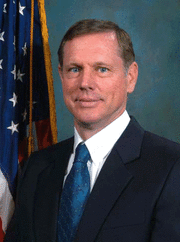
Kerry Gershaneck fmr US Govt Public Affairs Official fmr U.S. Marine Officer Senior Associate at Pacific Forum CSIS Adj. Prof. Hawaii Pacific University in Strategic Communications

Kerry Gershaneck
fmr US Govt Public Affairs Official
fmr U.S. Marine Officer
Senior Assoc, Pacific Forum CSIS
Adj. Prof. Hawaii Pacific University in Communications
Strategic Communications Expert

      In this program, “Asia in Review” host David Day engages in a fascinating conversation on this sensitive topic with special guest Ms. Hong Jiang, the Deputy Regional Director (for Hawaii) from the independent US-based TV network, New Tang Dynasty Television (NTDTV) and an Associate Professor at University of Hawaii at Manoa; Also joining Ms. Jiang is Mr. Kerry Gershaneck, a former senior US government Public Affairs official who teaches Strategic Communication at Hawaii Pacific University.

     The show focuses on the implications of this news media coverage imbalance and how it plays into the larger “information war” between the US and the PRC that former Secretary of State Clinton alluded to in testimony before Congress.  Ms. Jiang and Mr. Gershaneck address the question of whether this imbalance now gives the PRC a significant advantage in its “Soft Power” and other “influence operations” directed at the U.S. and what the U.S. can begin to do to level the Information playing field with the PRC.


American Eyes Inside North Korea’s Nuclear Facilities and Others

By Counter-Terrorism, Critical National / Regional Security Issues, Developments in Technology, Disaster Prep & Humanitarian Aid, Economic Development, Economic Security/Development, Energy, Food Security, Foreign Policy/Geopolitics, International Business, Intl Business in Asia, IT/Computer/Software, Korean Peninsula, Military, North Korea, North Korea, North Korea, Northeast Asia, Nuclear, Our Media
Nicole FinnemanFormerly, Korea Economic Institute, Washington, D.C.

Nicole Finneman
Formerly, Korea Economic Institute,
Washington, D.C


Hosted by David Day, this television program aired statewide in Hawaii and features, as its special guest, Ms. Nicole Finneman, formerly with the Korea Economic Institute in Washington, D.C.  Ms. Finneman, an American eyewitness inside North Korea’s Yongbyon nuclear facility and other fascinating facilities and locations throughout the country, talks about those experiences.

The conversation turns from the Yongbyon visit to the potential business and commerce development in North Korea and references American firms now lining up to do business in North Korea in the future, including the Korean-American-owned, Pyongyang University of Science and Technology (a private university).

Ms. Finneman talks about her visits to various commercial enterprises, the Koryolink mobile phone explosion in the country, and the market/commercial developments within the country. (Koryolink, a joint venture between the Egyptian company Orascom Telecom Holdings and the state-owned Korea Post and Telecommunications Corporation, is North Korea’s only 3G mobile operator.)

Nicole also discusses  her visit to the digital libraries at Kim Il Sung University and their remarkable high tech facilities which many universities in the U.S. currently do not have…but only connected to an intranet–no internet.

Finally, Ms. Finneman and David Day talk about the infrastructure for commerce and foreign investment that is now being put into place in North Korea and her crystal-ball view of the potential for change in that country.

Fall of Saigon: What Did We Accomplish and What have we learned?

By All Southeast Asia, Counter-Terrorism, Foreign Policy/Geopolitics, Military, Our Media, PRC/China, Vietnam

April 30, marks the 38th anniversary of the Fall of Saigon and the end of the Vietnam War for the United States. This year is also the 40th anniversary of the signing of the Paris Peace Accords. This program looks at the linkage between these two momentous events and how they impacted American and Vietnamese lives, Southeast Asia, as well as the Cold War.

Gene Castagnetti USMC Col. (Ret.) Director, U.S. Memorial Cemetary of the Pacific

Gene Castagnetti
USMC Col. (Ret.)
Director, U.S. Memorial Cemetery of the Pacific

In this conversation,  former combat USMC (ret) Col. Gene Castagnetti and Stanford’s Nguyen Van Canh examine the background of the U.S. involvement in Vietnam, the impact of the Paris Peace Accords, and then the collapse of the government and country of South Vietnam on April 30, 1975. Wars, like elections, have consequences, and the discussion includes a look at the downside of the U.S. withdrawal and the losses on the South Vietnamese side, the genocide, imprisonment, executions, re-education camps and then the bloodbath in Laos and Cambodia that followed. Both guests talk about the victory in Vietnam that has gone unrecognized and unappreciated as well as a theme of betrayal of our men and women in arms by our own political leadership.

Prof. Nguyen Van Canh Stanford University

Prof. Nguyen Van Canh
Stanford University


Hosted by David Day

The Awakening Tiger: The New Indonesia

By All Southeast Asia, Corruption in Business, Counter-Terrorism, Foreign Policy/Geopolitics, Indonesia, International Business Education, Intl Business in Asia, Our Media

International Lawyer David F. Day hosts a televised, talk show with Amin Leiman, CEO of the Hawaii-Indonesia Chamber of Commerce, on the some of the remarkable, recent changes that have taken place in this country that impact its economy, the potential for foreign investment and business in general.