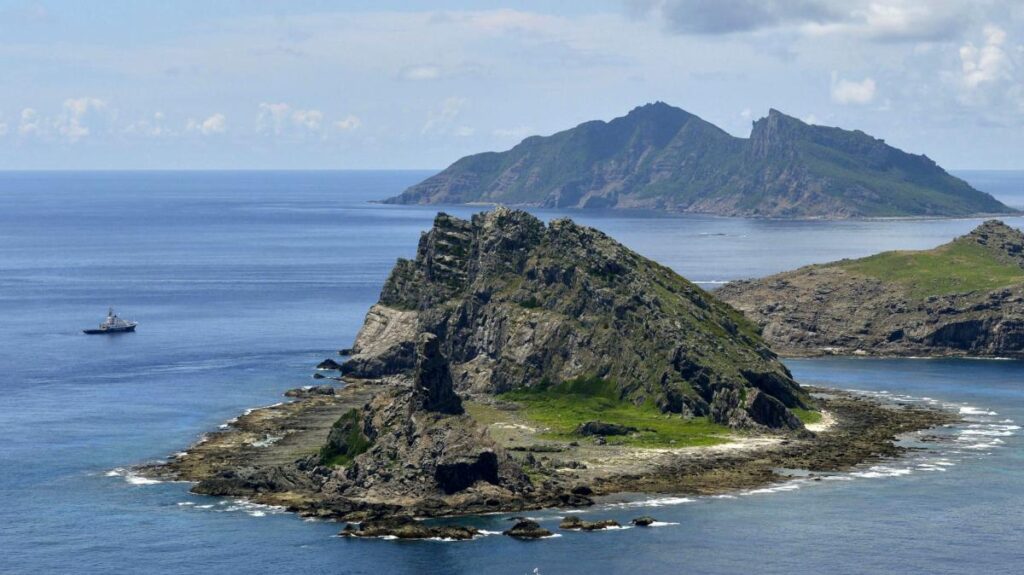
A massive, but flawed Fukushima/Tohoku response, the Senkaku islands confrontation with China, proposed amendments to Japan’s post-war Constitution regarding its defense capabilities, developments in relations with other regional militaries, the successful “Dawn Blitz” joint amphibious landing at Camp Pendleton with U.S. Marines, and then the Abe/Yasukuni visit…. what is actually happening on Japan’s military side that many are missing?
This program is about a new Japanese military with new, enhanced capabilities that have been achieved with remarkable speed over the past 18 months.
This week, Grant Newsham (formerly, Col. USMC), a Senior Research Fellow at the Japan Forum for Strategic Studies in Tokyo and formerly the U.S. Marine liaison officer with the Japan Self Defense Forces joins “Asia in Review” Host David Day for a fascinating discussion on this topic.
Mr. Newsham is also a former diplomat with the U.S. Embassy in Tokyo and formerly a Director of a major Tokyo financial firm.
So what are China’s next strategy moves in the Asia-Pacific Region? What does the PLA really think about the U.S. military and its capabilities? –a bizarre perception that encourages them to push harder now.
China has now been successful at establishing its Air Defense Identification Zone (ADIZ) in the South China Sea. In the process, we have seen a bizarre, almost schizophrenic, series of contradictory communications on the subject coming out of Washington that have enhanced China’s successful roll-out.
Following the roll-out, China’s lone aircraft carrier (sans aircraft) departed for the South China Sea for a “show the flag” cruise. Next, we witnessed a near collision by U.S. and Chinese naval ships in the South China Sea.
This program is Part 2 of the conversation between David Day and China-Hand Michael Sacharski. Mr. Sacharski has spent some 3+ decades in China, met and worked with various members of its leadership and has fascinating perspectives to share about China’s ADIZ planning & gameplan, its unexpected success in the imposition of its new ADIZ in the East China Sea, and what strategic moves we can now expect China to make in the Asia-Pacific Region in the near term. Mr. Sacharski is the CEO of Pacific Enterprise Capital.
Are there unusual crossovers of the new China ADIZ (Air Defense Identification Zone) with both Taiwan and South Korea? There are and the Taiwan piece is perhaps something that most people do not know. Is China’s new ADIZ over the Senkaku islands a precursor to further ADIZs China may have in mind? What is this new Air Defense Zone that China has imposed in the East China Sea all about? How did we get here? What about the schizophrenic, wires-crossed responses coming out of the Pentagon and the State Department?
[soliloquy id=”4254″]
“Asia in Review” host David Day engages in a fascinating conversation with special guest Michael Sacharski. Mr. Sacharski has lived and worked in China as an American executive and entrepreneur for some 3+ decades and shares some interesting insights into the Chinese thinking behind this new strategy. Mr. Sacharski is the CEO of Pacific Enterprise Capital.
America’s relationship with Taiwan has waxed and waned since 1949, when Nationalist forces fled there following defeat by the Communists on mainland China in a lengthy and bloody civil war.
Kerry Gershaneck, former US Marine Officer stationed in Taiwan
Following this disastrous defeat and retreat, the US provided the security umbrella and economic incentives that helped propel the Taiwan into one of Asia’s leading economic “Tigers”. Taipei, in turn, supported US foreign policy and military policies. In recent years, however, a number of factors have caused that once-close relationship to drift. Some analysts say that actions by Taiwan and the US have placed Taiwan on a trajectory towards absorption by the PRC.
As one analyst noted, “Taipei is doing more damage to its own ability to deter mainland coercion and military attack than any weapon the People’s Liberation Army could conceive. This damage represents a serious threat to Taiwan’s national security, and by extension to the national security of the U.S. and Japan.” And the U.S., for its part, appears increasingly ready to sacrifice its national security and regional stability–and its fundamental beliefs as a nation–by refusing to reverse this drift.
[soliloquy id=”3076″]
David Day hosts this illuminating conversation with Kerry Gershaneck, a former US government official previously responsible for both “front line defense” of Taiwan and for developing key security cooperation programs with its military forces.
Nicole Finneman Formerly, Korea Economic Institute, Washington, D.C
Hosted by David Day, this television program aired statewide in Hawaii and features, as its special guest, Ms. Nicole Finneman, formerly with the Korea Economic Institute in Washington, D.C. Ms. Finneman, an American eyewitness inside North Korea’s Yongbyon nuclear facility and other fascinating facilities and locations throughout the country, talks about those experiences.
The conversation turns from the Yongbyon visit to the potential business and commerce development in North Korea and references American firms now lining up to do business in North Korea in the future, including the Korean-American-owned, Pyongyang University of Science and Technology (a private university).
Ms. Finneman talks about her visits to various commercial enterprises, the Koryolink mobile phone explosion in the country, and the market/commercial developments within the country. (Koryolink, a joint venture between the Egyptian company Orascom Telecom Holdings and the state-owned Korea Post and Telecommunications Corporation, is North Korea’s only 3G mobile operator.)
Nicole also discusses her visit to the digital libraries at Kim Il Sung University and their remarkable high tech facilities which many universities in the U.S. currently do not have…but only connected to an intranet–no internet.
Finally, Ms. Finneman and David Day talk about the infrastructure for commerce and foreign investment that is now being put into place in North Korea and her crystal-ball view of the potential for change in that country.
April 30, marks the 38th anniversary of the Fall of Saigon and the end of the Vietnam War for the United States. This year is also the 40th anniversary of the signing of the Paris Peace Accords. This program looks at the linkage between these two momentous events and how they impacted American and Vietnamese lives, Southeast Asia, as well as the Cold War.
Gene Castagnetti USMC Col. (Ret.) Director, U.S. Memorial Cemetery of the Pacific
In this conversation, former combat USMC (ret) Col. Gene Castagnetti and Stanford’s Nguyen Van Canh examine the background of the U.S. involvement in Vietnam, the impact of the Paris Peace Accords, and then the collapse of the government and country of South Vietnam on April 30, 1975. Wars, like elections, have consequences, and the discussion includes a look at the downside of the U.S. withdrawal and the losses on the South Vietnamese side, the genocide, imprisonment, executions, re-education camps and then the bloodbath in Laos and Cambodia that followed. Both guests talk about the victory in Vietnam that has gone unrecognized and unappreciated as well as a theme of betrayal of our men and women in arms by our own political leadership.
The Gulf of Tonkin incident in early August of 1964 is a key point in American History. It is the flash of armed conflict that formally brought the United States into the Vietnam War (or, “American War” as the Vietnamese call it) through the passage of the Gulf of Tonkin Resolution. The actual history of this incident got all entangled in the politics of the time and resulted in a conventional wisdom/urban myth (check out the Wikipedia versionhere) which is 180 degrees from the actual facts.
In this program, Admiral Lloyd “Joe” Vasey, who investigated the incident contemporaneously, now sets the record straight. Interviewed by David Day, this is the very same Admiral Vasey that served as a junior officer to John McCain, Sr (Senator McCain’s father) during WW II and is the founder of the distinguished foreign policy thinktank in the Asia-Pacific Region, Pacific Forum, CSIS.
At the time this program was recorded, Admiral Vasey was 95 years old.
There were 2 U.S. destroyers involved in the Gulf of Tonkin incident. The first, the USS Maddox was fired upon on August 2, 1964. There was no dispute that the Maddox was engaged on August 2. There was a bullet hole in the ship to prove it. Because the Maddox carried sensitive and classified electronic equipment onboard, the USS Turner Joy was immediately dispatched to defend the Maddox and got between the Maddox and the incoming North Vietnamese patrol craft as its “shield.” It is the August 4 attacks on the Turner Joy that have been disputed by history. Admiral Vasey corrects the twisted history here.
Admiral Vasey wrote an extensive article in the August, 2010 issue of Proceedings, published by the U.S. Naval Institute, Annapolis, Maryland and reprints can be orderedhere.
Admiral Vasey was Chief of Staff for Commander Seventh Fleet. Subsequently, he commanded a fleet of destroyers, was Secretary to the Joint Chiefs of Staff, and chief strategist for CINCPAC. He served as a submarine officer in the invasion of North Africa and then in the Pacific through World War II.
This is Part 2 of the television series of discussions between Pacific Forum, CSIS’s Dr. Kevin Shepard and international Lawyer David F.Day on the complex issues behind the confrontation between the Koreas. This in-depth discussion includes and examination of the humanitarian crisis facing the international community should North Korea collapse, China’s 3 province economic policy and its impact on China’s view of North Korea, and the beginnings of private sector investment in North Korea.




Recent Comments