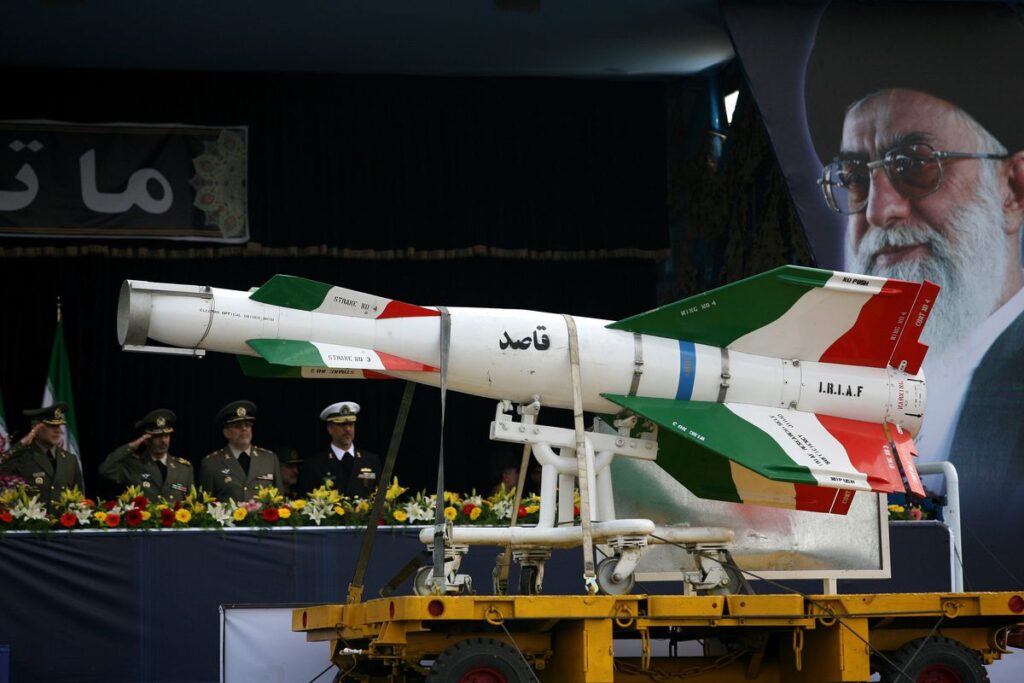
What is the nuclear deal that has been negotiated with Iran and just how did the U.S. get here?
There are serious questions as to whether it will succeed as there are areas where it does come up remarkably short. What does this initial deal really mean for future US relations with Iran, with Israel, and all the countries of the Middle East? What opportunities and risks does it hold for the US and the world?
David Day engages in a fascinating and educational conversation with Professor Jeswald Salacuse from the Fletcher School of Law and Diplomacy of Tufts University, and David Santoro, the nuclear expert at Pacific Forum CSIS in Honolulu. Dr. Salacuse is the former Dean of the Fletcher School, a prolific writer on the topic of international negotiations.
In this broadcast,“Asia-in- Review” Host Hong Jiang explores Russia’s recent foreign policy and geopolitical shifts into Asia followed by its fascinating energy moves into the Region with international business lawyer & professor, David Day.
[soliloquy id=”4152″]
The program starts with the recent Russian foreign policy moves into the Middle East after the U.S. Syria debacle, followed by the new Russian military arms sales to Egypt, and some discussion of Russia’s client nuclear state, Iran. The Russian geopolitical moves into Asia are next, as Hong Jiang discusses with Mr. Day, Putin’s recent trip to Vietnam, along with Russia’s (1) Kilo class submarine sales to Vietnam,(2) mutual defense pact, and then (3), new joint venture operations between Vietnam’s PetroVietnam and Russian energy companies for joint oil & gas exploration efforts in both the South China (“East Sea” in Vietnam) and the Artic Seas.
Next, the conversation turns to the critical and fascinating energy “pivot” that Russia is now engaged in, shifting its focus from its former European gas and oil pipeline customers to new pipeline developments with Japan, South Korea, and yes, even North Korea.
Russia’s foreign policy regarding The Korean Peninsula is also probed.
Nicole Finneman Formerly, Korea Economic Institute, Washington, D.C
Hosted by David Day, this television program aired statewide in Hawaii and features, as its special guest, Ms. Nicole Finneman, formerly with the Korea Economic Institute in Washington, D.C. Ms. Finneman, an American eyewitness inside North Korea’s Yongbyon nuclear facility and other fascinating facilities and locations throughout the country, talks about those experiences.
The conversation turns from the Yongbyon visit to the potential business and commerce development in North Korea and references American firms now lining up to do business in North Korea in the future, including the Korean-American-owned, Pyongyang University of Science and Technology (a private university).
Ms. Finneman talks about her visits to various commercial enterprises, the Koryolink mobile phone explosion in the country, and the market/commercial developments within the country. (Koryolink, a joint venture between the Egyptian company Orascom Telecom Holdings and the state-owned Korea Post and Telecommunications Corporation, is North Korea’s only 3G mobile operator.)
Nicole also discusses her visit to the digital libraries at Kim Il Sung University and their remarkable high tech facilities which many universities in the U.S. currently do not have…but only connected to an intranet–no internet.
Finally, Ms. Finneman and David Day talk about the infrastructure for commerce and foreign investment that is now being put into place in North Korea and her crystal-ball view of the potential for change in that country.
This is Part 2 of the television series of discussions between Pacific Forum, CSIS’s Dr. Kevin Shepard and international Lawyer David F.Day on the complex issues behind the confrontation between the Koreas. This in-depth discussion includes and examination of the humanitarian crisis facing the international community should North Korea collapse, China’s 3 province economic policy and its impact on China’s view of North Korea, and the beginnings of private sector investment in North Korea.


Recent Comments