Monthly Archives

December 2013

A Gift For You

By Blog, Economics, Economics

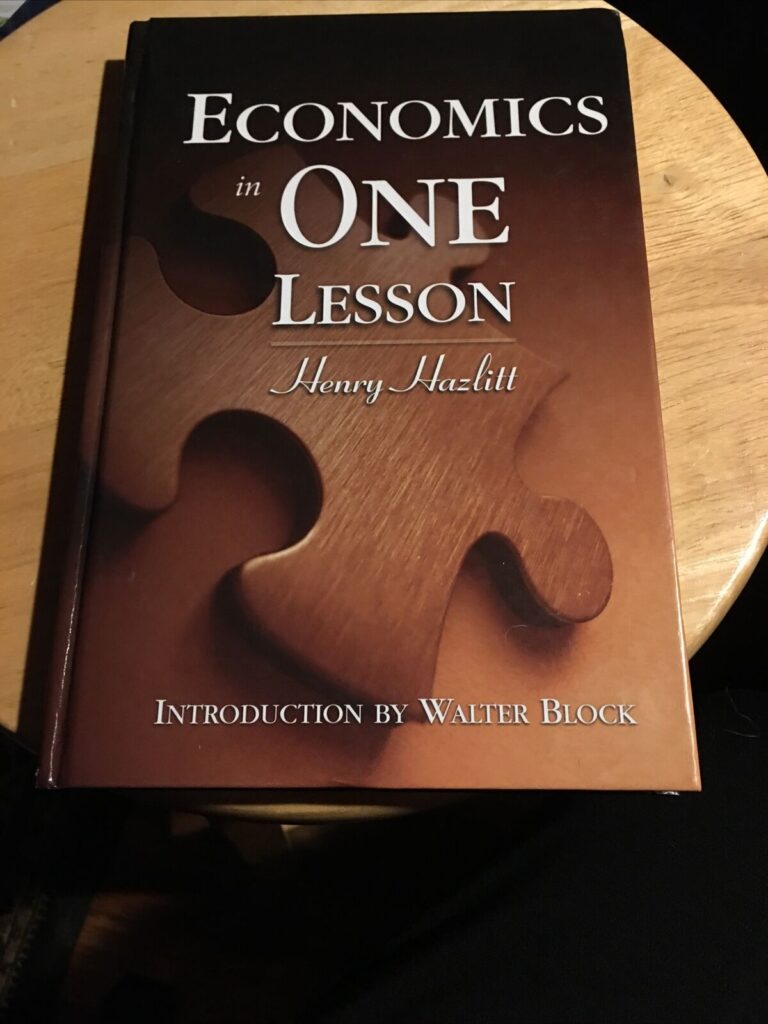
This is our gift to you: “Economics in One Lesson” by Henry Hazlitt                  Hazlitt book jacket

You will find the downloadable pdf  version below.

Our gift is the effort to get a copy into your possession in the hopes that you will read it. We also encourage you to forward copies to everyone that you know, including family, friends, business associates, and in particular give copies to every young person that you can. The book is an easy read, but contains wisdom that is often hard to come by these days.

Here is why we feel that this book is so important:

Most of the critical problems that we are facing in this country today stem from a rampant ignorance of basic economics. A Congress and an electorate that understood simple economics would never have allowed us to get into the budgetary wastefulness and debt crisis that the country now faces. Many people fail to understand that the laws of economics are like the laws of gravity–you ignore them at your peril.

Unfortunately most of our schools don’t teach this, and our children graduate without the necessary knowledge needed to make sound financial and life altering decisions in later life. This book is only a start, but it can be the seed that germinates into the fruit that drives the quest for knowledge and truth. This is true regardless of your political leanings or religious beliefs, and we truly hope that you will benefit from it.

Here is the book description as listed at the Mises Institute, where this and many other related books can be found:

Henry Hazlitt wrote this book following his stint at the New York Times as an editorialist. His hope was to reduce the whole teaching of economics to a few principles and explain them in ways that people would never forget. It worked. He relied on some stories by Bastiat and his own impeccable capacity for logical thinking and crystal-clear prose.

He was writing under the influence of Mises himself, of course, but he brought his own special gifts to the project. As just one example, this is the book that made the idea of the “broken window fallacy” so famous. Concise and instructive, it is also deceptively prescient and far-reaching in its efforts to dissemble economic fallacies that are so prevalent they have almost become a new orthodoxy.

This is the book to send to reporters, politicians, pastors, political activists, teachers, or anyone else who needs to know. It is probably the most important economics book ever written in the sense that it offers the greatest hope to educating everyone about the meaning of the science.

Many writers have attempted to beat this book as an introduction, but have never succeeded. Hazlitt’s book remains the best. It’s still the quickest way to learn how to think like an economist. And this is why it has been used in the best classrooms for more than sixty years.”

Economics in One Lesson

China’s Next Moves Following its East China Sea ADIZ

By All Southeast Asia, Blog, China, China, Critical National / Regional Security Issues, Foreign Policy/Geopolitics, Japan, Japan, Korean Peninsula, Military, Mongolia, Northeast Asia, Our Media, Philippines, PRC/China, Regional Security/Flashpoints, Russia, Russia, Senkakus, South China Sea Claims, South Korea, South Korea, Taiwan Straits, Vietnam, Vietnam

So what are China’s next strategy moves in the Asia-Pacific Region? What does the PLA really think about the U.S. military and its capabilities? –a bizarre perception that encourages them to push harder now.

China has now been successful at establishing its Air Defense Identification Zone (ADIZ) in the South China Sea. In the process, we have seen a bizarre, almost schizophrenic, series of contradictory communications on the subject coming out of Washington that have enhanced China’s successful roll-out.

Following the roll-out,  China’s lone aircraft carrier (sans aircraft) departed for the South China Sea for a “show the flag” cruise. Next, we witnessed a near collision by U.S. and Chinese naval ships in the South China Sea.

This program is Part 2 of the conversation between  David Day and China-Hand Michael Sacharski. Mr. Sacharski has spent some 3+ decades in China, met and worked with various members of its leadership and has fascinating perspectives to share about China’s ADIZ planning & gameplan, its unexpected success in the imposition of its new ADIZ in the East China Sea, and what strategic moves we can now expect China to make in the Asia-Pacific Region in the near term. Mr. Sacharski is the CEO of Pacific Enterprise Capital.

Negotiating the The Nuclear Deal with Iran

By Critical National / Regional Security Issues, Foreign Policy/Geopolitics, Iran, Iran, Iran, Middle East, Nuclear, Nuclear/uranium enrichment, Our Media

What is the nuclear deal that has been negotiated with Iran and just how did the U.S. get here?

There are serious questions as to whether it will succeed  as there are areas where it does come up remarkably short. What does this initial deal really mean for future US relations with Iran, with Israel, and all the countries of the Middle East? What opportunities and risks does it hold for the US and the world?

David Day engages in a fascinating and educational conversation with  Professor Jeswald Salacuse from the Fletcher School of Law and Diplomacy of Tufts University, and David Santoro, the nuclear expert at Pacific Forum CSIS in Honolulu. Dr. Salacuse is the former Dean of the Fletcher School, a prolific writer on the topic of international negotiations.

China’s New ADIZ

By Blog, China, China, Critical National / Regional Security Issues, Foreign Policy/Geopolitics, Japan, Japan, Korean Peninsula, Military, Northeast Asia, Our Media, PRC/China, Regional Security/Flashpoints, Senkakus, South China Sea Claims, South Korea, South Korea, Taiwan, Taiwan Straits

Are there unusual crossovers of the new China ADIZ (Air Defense Identification Zone) with both Taiwan and South Korea? There are and the Taiwan piece is perhaps something that most people do not know.   Is China’s new ADIZ over the Senkaku islands a precursor to further ADIZs China may have in mind? What is this new Air Defense Zone that China has imposed in the East China Sea all about? How did we get here? What about the schizophrenic, wires-crossed responses coming out of the Pentagon and the State Department? 


[soliloquy id=”4254″]


Asia in Review” host David Day engages in a fascinating conversation with special guest Michael Sacharski. Mr. Sacharski has lived and worked in China as an American executive and entrepreneur for some 3+ decades and shares some interesting insights into the Chinese thinking behind this new strategy. Mr. Sacharski is the CEO of Pacific Enterprise Capital.