
This is Part 2 of the television series of discussions between Pacific Forum, CSIS’s Dr. Kevin Shepard and international Lawyer David F.Day on the complex issues behind the confrontation between the Koreas. This in-depth discussion includes and examination of the humanitarian crisis facing the international community should North Korea collapse, China’s 3 province economic policy and its impact on China’s view of North Korea, and the beginnings of private sector investment in North Korea.
In a televised, talk show hosted by Bill Sharp, David Day discusses the historical background of corruption in most parts of Asia, why it is critical for businesses to develop ethical practices and codes of conduct and how they directly impact the company’s bottom line. This program also includes some practical tips on how common types of corruption can be ethically handled.
International Lawyer David F. Day hosts a televised, talk show with Amin Leiman, CEO of the Hawaii-Indonesia Chamber of Commerce, on the some of the remarkable, recent changes that have taken place in this country that impact its economy, the potential for foreign investment and business in general.
65 years Ago -While Japan surrendered aboard the Battleship Missouri in Tokyo Bay, Vietnam Declared Independence with the words of Thomas Jefferson
By David Day September 3, 2010.
Happy 65th Independence Day (September 2, 1945) to all of my Vietnamese friends and colleagues in Vietnam and abroad.
-

Ho Chi Minh at the independence day of Democratic Republic of Vietnam, September 2, 1945

Most Americans do not know that it was on this date, as the formal Japanese surrender ceremonies were taking place aboard the battleship Missouri in Tokyo Bay, that Ho Chi Minh declared Vietnam’s independence from colonial rule. He stepped up to a rostrum in Hanoi’s Ba Dinh Square and, carefully borrowing the key portion of the precise text of Thomas Jefferson, delivered the Declaration of Independence of the Democratic Republic of Vietnam. The English translation of this portion Ho’s exact text is as follows:
” ‘All men are created equal. They are endowed by their
Creator with certain inalienable rights, among these are Life,
Liberty, and the pursuit of Happiness….’
This immortal statement was made in the Declaration
of Independence of the United States of America m 1776. In
a broader sense, this means: All the peoples on the earth are
equal from birth, all the peoples have a right to live, to be
happy and free.” (–President Ho Chi Minh).
Most Americans do not know this history. They also do not know that Uncle Ho carefully worked over this portion of his text with his American OSS colleagues by communications with them from a shophouse in Hanoi’s Old Quarter where he worked on the draft Declaration. Some of his OSS colleagues were there in the crowd at Ba Dinh Square when he delivered this famous Declaration of Independence.

Ho Chi Minh and Vo Nguyen Giap (in white suit) with American colleagues in the OSS “Deer Team” at Pac Bo Vietnam in the Summer of 1945
Another interesting pinprick of history here is that elderly people (now) in Hanoi who were on hand to witness Uncle Ho’s Declaration of Independence have told me that during the course of Uncle Ho’s speech, they looked up in the sky above his head and could see the insignia on an American warplane flying overhead (to presumably witness this historic event or to show support).
We were friends with Uncle Ho then and today, he would be pleased that the United States and Vietnam are now friends once again.
Happy 65th Independence Day!
A New Negotiating Strategy with Myanmar’s General Than Shwe
May 18, 2009 by davidfday

Myanmar’s General Than Shwe
On the eve of Daw Suu Kyi’s show trial as a consequence of the Missouri swimmer, it is easy to see the double jeopardy created by this seemingly harmless event, just as Aung Sang Suu Kyi’s long suffering period of house arrest was coming to a close. It would appear to be the perfect set-up/excuse for General Than Shwe and the Burmese junta to shove Daw Suu Kyi back into detention or worse. She was so close to being free…or so the world thought.
Washington has handled the 1990 election freeze-out of Daw Suu Kyi in an understandable, but clearly ineffective, “ice-out attempt” strategy. That confrontive negotiation strategy with General Than Shwe and his Generals is regime-threatening and has a 19-year track record of going nowhere. Worse, the denial of aid and business sanctions have punished the Burmese people terribly, but have not scratched the junta leadership.
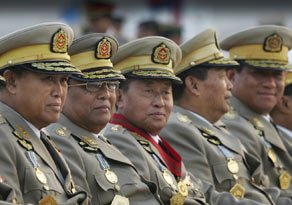
Members of Myanmar’s ruling junta are shown during an Armed Forces Day ceremony
The U.S. military’s (out of the Pacific Command) Cyclone Nargis humanitarian aid negotiations have provided a partial key in terms of strategy development vis.a.vis negotiating with General Than Shwe. That partial key (let’s call it Part 1 of 2) is that the tactic must not be perceived as “regime threatening.” Success with Myanmar will not come by the historic (but naïve) approach of rejecting Burma’s constitution and the sham referendum which ratified that constitution. That is “regime-threatening” and, as a negotiation strategy, it is a dead end. Similarly, insistence upon requiring General Than Shwe and his “State Peace and Democracy Council” (SPDC) release Daw Suu Kyi and some 2000 plus political prisoners, engage in a dialogue with Kyi’s political party, the “National League for Democracy” (NLD), is also regime-threatening and not going to achieve anything. Kyi’s trial will be a sham and Myanmar’s hopes for democracy will be put on ice a while longer. She cannot be forced into power at this juncture.
Once the “regime-threatening” Part 1 is understood and appreciated, a successful negotiation strategy emerges if it is combined with a Part 2 piece. Part 2 was interestingly delivered by Myanmar’s Prime Minister Thein Sein at the ASEAN summit in Thailand. There is a national election coming up in Myanmar in 2010. Prime Minister Sein has stated that Burma would allow the United Nations to monitor that election. So, Part 2 of the successful negotiating strategy is to set aside the “regime threatening,” and get ASEAN, Washington, and other concerned nations to hold the Burmese to their word. 2010 elections monitored by the United Nations. A strategy that bears a strong resemblance to the voter registration efforts in the Philippines of NAMFREL that ultimately unseated Ferdinand Marcos and brought Corazon Aquino to power in February of 1986.
There is more to Part 2 of the strategy, though. Kyi’s NLD must not be allowed to boycott the 2010 elections and simply cede the results back over to Than Shwe. The NLD must be encouraged to participate to the fullest extent possible.
Recent Comments