Category

Blog

A Different Focus on North Korea – Business Reunification Out Over the Horizon

By Articles, Blog, China, Foreign Policy/Geopolitics, International Business, Korean Peninsula, North Korea, North Korea, North Korea, Northeast Asia, Regional Security/Flashpoints, Russia, South Korea, South Korea, South Korea


A Different Focus on North Korea – Business Reunification Out Over the Horizon

May 31, 2009 by davidfday

Negotiating table for the 6 Party talks.

Negotiating table for the 6 Party talks.


This is what the real Six Party Talks looked like.

The recent nuclear and missile tests combined with threats bandied about by Pyongyang present an ominous, threatening view of attention-grabbing brinksmanship. It is worrisome, to be sure. Negotiations to handle North Korea, or get them back to the table at least, will be a new and different challenge for Special Envoy, Stephen Bosworth, who is no stranger to difficult negotiations—after all, as the America Ambassador in Manila in 1986, he was one of the principal players in successfully negotiating the Marcoses out of Malacanang Palace and eventually out of the country. Remember, the Philippine situation in the mid-1980’s was still a very touchy matter. There were a million people exposed in the streets sandwiched between the armed forces of Juan Ponce Enrile and General Ver. North Korea will be an entirely different ballgame for many reasons.

To be sure, there will be plenty of commentary about North Korea, its threats, and the destabilizing prospect it exhibits for Northeast Asia.

One thing is for sure. Beyond the nuclear tests, bellicose threats and serious potential for a regime implosion with its humanitarian crisis to follow, there are prospects for a stabilized and developing future for the country out over the horizon. We never hear much about this possibility. It is just that very few people focus on the opportunities that are coming as the country eventually stabilizes and begins to open up.

DHL is.

DHL Vans in service in Pyongyang

DHL Vans in Pyongyang

Given the current deteriorating health of the Dear Leader, we are now entering the transition period for the regime.

Vietnam Looking to Elbow a Place with China and India with Foreign Investors

By All Southeast Asia, Articles, Blog, China, International Business, Vietnam, Vietnam

Vietnam Looking to Elbow a Place with China and India with Foreign Investors

By David Day. August 2010

For Vietnam, stepping onto the world stage in recent years has meant admission to the WTO, a Nonpermanent seat on the UN Security Council, launching the country’s first telecommunications satellite (Vinasat 1 built by Lockeed Martin) and hosting the APEC Summit in Hanoi.

Lockeed-Martin’s Vinasat 1

Vietnam continues to weather the global recession in reasonably well with foreign investment possibly doubling to $15 billion this year. Its largest export market is now the U.S. with over $12 billion last year. This Fall will see Intel’s new $1 billion chip assembly plant open outside Ho Chi Minh City.

Vietnam is now poised for yet another breakthrough. Political tensions in Thailand are helping Vietnam to get onto contingent plan target lists of foreign investors seeking political stability. Political stability is one factor working in Vietnam’s favor now. Another is labor costs. Vietnam is attempting to capitalize on the 30 to 40% labor differential with manufacturing plants in China. This is a huge incentive for China-based operations to begin looking to the south. The labor cost differential with China has been compounded by other problems nagging China operations: labor strikes and shortages.

Outside of the tech industry, where Vietnam has done very well in terms of attracting foreign investment, its aging colonial infrastructure has been a hindrance to all kinds of foreign investment.

There are two recent developments in Vietnam that will catapult the country forward in terms of attracting foreign investment at this critical juncture during the global recession. The first is the development of a number of major superhighway systems north of Hanoi that will link into highway systems in southern China. These new highways will allow a supply chain linkage between Chinese and Vietnamese manufacturing operations.

The second is a proposed Shinkansen-like bullet train between Ho Chi Minh City and Hanoi. The proposed bullet train, which would be completed by 2035, would travel the 1,600 km from Hanoi in the north to Ho Chi Minh City in the south in less than six hours. Vietnam’s current charming but woefully outdated trains take more than two days to make the trip. While this $56 billion project has recently been rejected by the National Assembly, Japan’s Transport Ministry continues to voice support for the project and has promised assistance should the Vietnamese government ultimately decide to proceed with the project once concerns of National Assembly members are adequately addressed (we believe that this is likely to occur despite the current clamor). Vietnam Railways Corp. was planning to use Japanese technology to build the high-speed train line. Sumitomo Corp. had teamed with Mitsubishi Heavy Industries Ltd. to bid on the project. Itochu Corp. was heading a competing group with Kawasaki Heavy Industries Ltd.

Proposed Vietnamese “Shinkansen” Linking Hanoi & HCMC

Given the importance of a high-speed rail link between Hanoi and Ho Chi Minh City, and the challenges Vietnam Airlines, and its related carriers have in meeting the staggering business traffic demands between the two cities, a Vietnamese “Shinkansen” would be an enormous contribution to the national infrastructure. No question that Vietnamese officials are eyeing the success of the Tokyo-Osaka Shinkansen as a precedent for a sorely needed rail upgrade in their own country.

Financing the north-south linkage is another matter.

New Business Models, IP & Corruption

By Anti-corruption, Articles, Blog, China, China, Intellectual Property, International Business

New Business Models, IP & Corruption

April 18, 2009 by davidfday

These two Videos, both dated April  17, 2009, illustrate the broad ends of the intellectual property spectrum vis.a.vis copyright infringement.  Google setting up free downloads in China in concert with music labels in effort to capture part of share of advertising revenue.  Essentially, this  is the “Free” business model developing in the digital world.

http://edition.cnn.com/video/#/video/showbiz/2009/04/17/chang.china.google.w.music.cnn

On the very same date, contrast Google’s new tactic in China with the 2nd video which is the conviction of 4 persons involved in the Pirate Bay website in Sweden for the crime of copyright violations. This is the “classic” intellectual property prosecution which may become a thing of the past if the Google model in China really takes hold.

http://edition.cnn.com/video/#/video/international/2009/04/17/curry.pirate.bay.verdict.cnn

China’s Confrontation in the Yellow Sea — Part of a Broader Strategy?

By All Southeast Asia, Articles, Blog, China, China, Energy, Energy, Foreign Policy/Geopolitics, Resource management/Extraction, Vietnam, Vietnam


China’s Confrontation in the Yellow Sea — Part of a Broader Strategy?

May 6, 2009 by davidfday

This most recent PRC interference with a U.S. Navy ship in the Yellow sea these past few days appears consistent with an ongoing, stepped-up PRC policy looking towards an expansion of its territorial claims well into international waters. To be sure, China’s territorial waters claims are not new, it is just that we are now seeing more aggressive and confrontational action on the part of the PRC. This most recent China/U.S. naval confrontation in the Yellow Sea follows last month’s nearly mirror-image confrontations of the U.S. Impeccable in the South China sea. These events bear careful watching as they pose the risk of misunderstanding, miscalculation and injury not only to the U.S. and China, but to competing territorial claimants in the Region as well as international maritime players.

China's Claim to the South China Sea

Complicating this picture, we need to be mindful that Hanoi, having finally resolved a 30-year northern border dispute with China, is beginning now to focus on its age-old dispute with China over the South China sea’s Paracel and Spratley Islands. While, to be sure there are other national interests claimed over these islands, the Vietnamese are the most likely to pose intense resistance to China’s claims in the South China Sea.

Known Oil fields Overlayed with Competing Territorial Claims

Myanmar’s Dance

By All Southeast Asia, Articles, Blog, China, China, Energy, Energy, Foreign Policy/Geopolitics, Indonesia, Indonesia, International Business, Myanmar/Burma, Myanmar/Burma

Myanmar sits between India and China, a key strategic position combined with extraordinary natural resources.

Historically, in its post-British colonial era, Myanmar has “danced” in its foreign policy and sought to maintain its neutrality, wary of foreigners. Myanmar’s dance continued throughout the Cold War as a strategy necessary to preserve its own sovereignty. This wariness extended to Western diplomats and China alike. However, as the General Than Shwe/Junta era began to take hold and the resulting U.S. sanctions began to bite, Myanmar “leaned” heavily towards China as its sanctions bypass route.

The new Thein Sein government started to shake the West with its political reforms and the release of political prisoners, including Aung San Suu Kyi. These reforms also included legal changes that would now permit Aung San Suu Kyi to run for political office. Indeed, her party, the National League for Democracy, has seized upon this legal change, re-registered under the new law, and Aung San Suu Kyi herself has formally announced that she would run in the next elections.

Then there is the pushback against China commenced with the abrupt decision to suspend the construction of a controversial China-backed hydroelectric dam that would have flooded an area the size of Singapore. Given the magnitude of Chinese investment and influence in Myanmar, this has been a stunning move.

The question then becomes, what is the next step in Myanmar’s dance? That step will be heavily influenced by Myanmar’s bid to assume its leadership bid as ASEAN’s chair in 2014. However, Myanmar’s bid for the 2014 ASEAN chairmanship means that it will have to present itself as an ASEAN member and not China’s little client. In order to accomplish that by 2014, we are going to see a number of previously unthinkable reforms coming out of Naypyidaw. The notion that Suu Kyi will now run for election is but one example of the previously unthinkable.

Indonesia, interestingly, is playing a key role from its ASEAN leadership chair position, steering Myanmar in a reform-minded direction so as to position and prepare Myanmar for its own 2014 ASEAN chair. Coupled with Jakarta’s efforts, the current United States efforts on the” pivoting” front to re-engage with Asia, such as entering the East Asia Summit and cultivating stronger ties with Southeast Asia, also contains a strategy designed to encourage Myanmar into further reforms. To that end, Secretary of State Hillary Clinton recently dangled the bait that Myanmar would find a partner in the U.S. if further reforms were made. The possibility of removing sanctions and promises of cooperation will assist in expanding U.S. influence with Myanmar,and likely move the country into a more balanced relationship between the U.S. and China.

Myanmar took Clinton’s bait, Suu Kyi and her party are now planning to participate in the next elections, and Clinton herself is now “pivoting” and enroute to Myanmar. The winds are now shifting in the U.S./Myanmar relationship. New partners and new steps are now in play.

The China relationship is still out there. While there is a certain frostiness to the current relations between China and Myanmar, it must be remembered that Myanmar must live with China next door and its dance in the future will always need to maintain considerable weight on that foot.

The Negotiations Master—Kim Jong Il still has it

By Articles, Blog, China, China, China, Energy, Energy, Foreign Policy/Geopolitics, International Business, Japan, Japan, Korean Peninsula, North Korea, North Korea, North Korea, Northeast Asia, Oil & Gas, Resource management/Extraction, Russia, Russia, South Korea, South Korea, South Korea

The Negotiations Master—Kim Jong Il still has it

By David Day

Over the past year, we have watched the Dear Leader’s private train slide into China on several occasions with educated speculation that he was paving the way for a baton hand-off in Pyongyang to Kim Jong Eun. There was a need, it was argued, for Beijing to bless the heir apparent. Some of these China visits included factory tours, fueling the speculation that the Kim Regime was preparing to “open up” and was ready now for some type of economic liberalization. These visits were followed by, more recently, announcements of large China-fueled infrastructure projects just inside the North Korean border.

Kim Jong Il’s current trip to Russia was not just to provide a change of scenery or demonstrate that there are places he can visit other than the PRC. Despite his age and frail health, the Dear Leader still retains his tactical genius. The Russian trip suggests the timing and the key trump card that Kim Jong Il may soon play—the Trans- Siberia/Korean pipeline.

Russia and South Korea have already entered into a MOU for a huge US$90 billion deal between Russia’s Gazprom and South Korea’s state-owned KoGas. The latter, the world’s largest single buyer of natural gas, will take 10 billion cubic meters annually for 30 years – via a pipeline to be built across North Korea. The sticking point in this enormous energy deal is, of course, North Korea. This week, North Korea also inked the same accord.

The tactical genius of Kim Jong Il is now beginning to surface.  2012 is a Presidential election year in South Korea and President Lee Myung-bak, an uncomfortable hard-liner for the North, is now on his way out. 2012 is also the magical, propagandized, “Mighty and Prosperous Nation” year (the 100th anniversary of the birth of the Great Leader, Kim Il Sung, the 70th birthday of the Dear Leader, Kim Jong Il, and the 30th birthday (give or take) of the heir apparent, “Brilliant Comrade,” Kim Jong Eun—the 100, 70, 30 numbers are significant in the North Korean culture).

There is one other piece to this puzzle and that is Japan. Fukushima and Japan’s nuclear domino shutdowns/decommissionings have left certain parts the country desperately short of energy. This Summer, Tokyo Electric has been able to manage as a result of drastic austerity measures. In the reasonably short term future, Japan will find it impossible to fill its resulting power gap with renewables. Natural gas and coal are the only practical alternatives, with the cleaner, natural gas being the preferred choice. Russian natural gas piped to Busan, South Korea is going to open up critical and easier access for Japan.

As for the tactical genius, Kim can balance China’s growing influence on North Korea with both Russian and South Korean financial influence in the form of a mixture of pipeline lease rent and energy which the North Korean grid sorely needs. A deal to move forward with a pipeline has the added bonus of fitting squarely with the needs of the Pyongyang “Mighty and Prosperous Nation” propaganda machine to have something significant to announce for 2012.

A key issue which Russia and South Korea will undoubtedly have to be concerned with is the pipeline “valve” question (see, the North Korean shutdown of the Mt. Geumgang resort as an example).

Perhaps the economics will force the valve to remain open, but they need to be prepared that Pyongyang will be maneuvering to retain control. Yet another flash of Kim Jong Il’s tactical genius is in the works.

Yet Another China Foreign Policy Stumble: The South China Sea

By All Southeast Asia, All Southeast Asia, Articles, Blog, China, China, China, Energy, Food Security, Foreign Policy/Geopolitics, Oil & Gas, Philippines, Regional Security/Flashpoints, Resource management/Extraction, South China Sea Claims, Vietnam, Vietnam, Vietnam

China has had a number of foreign policy gaffes over the past couple of years and its very recent attempt at imposing a fishing ban in the South China Sea (known to the Vietnamese as the “East Sea”) is yet another stumble.  Attempting to protect and encourage the replenishment of fishing stock during the spawning season, China announced on May 11, 2011 a fishing ban to run from May 16 through August 1 over an area hotly contested by several South East Asia countries, most notably by Vietnam.

While replenishing the fishing stock may well be a noble ideal, China’s unilateral action is guaranteed to gin up a firey defiance by the Vietnamese, with fishermen ignoring the ban, boat seizures and violent confrontations– all too predictable.

Vietnam has a 1000 mile coastline to protect and its Eastern Sea is an essential part of its defense perimeter that it has, and will continue to jealously protect. China knows this all too well– given its historical battles and scrapes with Vietnam in these same waters over the millennia.

China’s unilateral muscle-flexing in the South China Sea is hardly simply to protect the  fishing stock which Vietnam’s marine industry depends upon. China had to know full well that its fishing ban would necessarily force a response from Vietnam  and give the PRC an opportunity to reinforce its imprimatur over the disputed waters.

For Vietnam, the Eastern Sea is its “line in the sand.”  Vietnamese public opinion will not stand for any moves by China to nip bites out of Vietnamese waters. China knows this but its policymakers blundered ahead anyway.

Defiance by little colorful Vietnamese fishing boats is one thing. China did not anticipate, however, the announcement by the Vietnamese Navy that it now intends to conduct live firing exercises off of Vietnam’s central coast directly into waters affected by the fishing ban.

Such are the perils of unilateralism–especially when you have a little sleeping tiger to the south.

A Heartbreaker

By Blog, Japan

More often than not, a picture will do what words simply cannot.

To all of our special friends in Japan, we are with you and we pray for you.  She will stand again.

Ganbare, Nippon! Ganbare.

Wording of Vietnam’s Declaration of Independence Subject of Communications between Ho Chi Minh and His American Collegues in the OSS

By All Southeast Asia, Articles, Blog, Ho Chi Minh, Vietnam, Vietnam, Vietnam History-related

65 years Ago -While Japan surrendered aboard the Battleship Missouri in Tokyo Bay, Vietnam Declared Independence with the words of Thomas Jefferson

By David Day September 3, 2010.


Happy 65th Independence Day (September 2, 1945) to all of my Vietnamese friends and colleagues in Vietnam and abroad.

Ho Chi Minh at the independence day of Democratic Republic of Vietnam, September 2, 1945

Most Americans do not know that it was on this date, as the formal Japanese surrender ceremonies were taking place aboard the battleship Missouri in Tokyo Bay, that Ho Chi Minh declared Vietnam’s independence from colonial rule. He stepped up to a rostrum in Hanoi’s Ba Dinh Square and, carefully borrowing the key portion of the precise text of Thomas Jefferson, delivered the Declaration of Independence of the Democratic Republic of Vietnam. The English translation of this portion Ho’s exact text is as follows:

” ‘All men are created equal. They are endowed by their
Creator with certain inalienable rights, among these are Life,
Liberty, and the pursuit of Happiness….’

This immortal statement was made in the Declaration
of Independence of the United States of America m 1776. In
a broader sense, this means: All the peoples on the earth are
equal from birth, all the peoples have a right to live, to be
happy and free.” (–President Ho Chi Minh).

Most Americans do not know this history. They also do not know that Uncle Ho carefully worked over this portion of his text with his American OSS colleagues by communications with them from a shophouse in Hanoi’s Old Quarter where he worked on the draft Declaration. Some of his OSS colleagues were there in the crowd at Ba Dinh Square when he delivered this famous Declaration of Independence.

Ho Chi Minh and Vo Nguyen Giap (in white suit) with American colleagues in the OSS “Deer Team” at Pac Bo Vietnam in the Summer of 1945

Another interesting pinprick of history here is that elderly people (now) in Hanoi who were on hand to witness Uncle Ho’s Declaration of Independence have told me that during the course of Uncle Ho’s speech, they looked up in the sky above his head and could see the insignia on an American warplane flying overhead (to presumably witness this historic event or to show support).
We were friends with Uncle Ho then and today, he would be pleased that the United States and Vietnam are now friends once again.

Happy 65th Independence Day!


A New Negotiating Strategy with Myanmar’s General Than Shwe

By All Southeast Asia, Articles, Blog, Myanmar/Burma, Myanmar/Burma

A New Negotiating Strategy with Myanmar’s General Than Shwe

May 18, 2009 by davidfday

MyanMar's General Than Shwe

Myanmar’s General Than Shwe

On the eve of Daw Suu Kyi’s show trial as a consequence of the Missouri swimmer, it is easy to see the double jeopardy created by this seemingly harmless event, just as Aung Sang Suu Kyi’s long suffering period of house arrest was coming to a close. It would appear to be the perfect set-up/excuse for General Than Shwe and the Burmese junta to shove Daw Suu Kyi back into detention or worse. She was so close to being free…or so the world thought.

Washington has handled the 1990 election freeze-out of Daw Suu Kyi in an understandable, but clearly ineffective, “ice-out attempt” strategy. That confrontive negotiation strategy with General Than Shwe and his Generals is regime-threatening and has a 19-year track record of going nowhere. Worse, the denial of aid and business sanctions have punished the Burmese people terribly, but have not scratched the junta leadership.

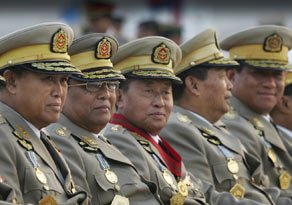
Members of Myanmar's ruling junta are shown during an Armed Forces Day ceremony

Members of Myanmar’s ruling junta are shown during an Armed Forces Day ceremony

The U.S. military’s (out of the Pacific Command) Cyclone Nargis humanitarian aid negotiations have provided a partial key in terms of strategy development vis.a.vis negotiating with General Than Shwe. That partial key (let’s call it Part 1 of 2) is that the tactic must not be perceived as “regime threatening.” Success with Myanmar will not come by the historic (but naïve) approach of rejecting Burma’s constitution and the sham referendum which ratified that constitution. That is “regime-threatening” and, as a negotiation strategy, it is a dead end. Similarly, insistence upon requiring General Than Shwe and his “State Peace and Democracy Council” (SPDC) release Daw Suu Kyi and some 2000 plus political prisoners, engage in a dialogue with Kyi’s political party, the “National League for Democracy” (NLD), is also regime-threatening and not going to achieve anything. Kyi’s trial will be a sham and Myanmar’s hopes for democracy will be put on ice a while longer. She cannot be forced into power at this juncture.

Once the “regime-threatening” Part 1 is understood and appreciated, a successful negotiation strategy emerges if it is combined with a Part 2 piece. Part 2 was interestingly delivered by Myanmar’s Prime Minister Thein Sein at the ASEAN summit in Thailand. There is a national election coming up in Myanmar in 2010. Prime Minister Sein has stated that Burma would allow the United Nations to monitor that election. So, Part 2 of the successful negotiating strategy is to set aside the “regime threatening,” and get ASEAN, Washington, and other concerned nations to hold the Burmese to their word. 2010 elections monitored by the United Nations. A strategy that bears a strong resemblance to the voter registration efforts in the Philippines of NAMFREL that ultimately unseated Ferdinand Marcos and brought Corazon Aquino to power in February of 1986.

There is more to Part 2 of the strategy, though. Kyi’s NLD must not be allowed to boycott the 2010 elections and simply cede the results back over to Than Shwe. The NLD must be encouraged to participate to the fullest extent possible.