Tag

ASEAN

Myanmar’s Dance

By All Southeast Asia, Articles, Blog, China, China, Energy, Energy, Foreign Policy/Geopolitics, Indonesia, Indonesia, International Business, Myanmar/Burma, Myanmar/Burma

Myanmar sits between India and China, a key strategic position combined with extraordinary natural resources.

Historically, in its post-British colonial era, Myanmar has “danced” in its foreign policy and sought to maintain its neutrality, wary of foreigners. Myanmar’s dance continued throughout the Cold War as a strategy necessary to preserve its own sovereignty. This wariness extended to Western diplomats and China alike. However, as the General Than Shwe/Junta era began to take hold and the resulting U.S. sanctions began to bite, Myanmar “leaned” heavily towards China as its sanctions bypass route.

The new Thein Sein government started to shake the West with its political reforms and the release of political prisoners, including Aung San Suu Kyi. These reforms also included legal changes that would now permit Aung San Suu Kyi to run for political office. Indeed, her party, the National League for Democracy, has seized upon this legal change, re-registered under the new law, and Aung San Suu Kyi herself has formally announced that she would run in the next elections.

Then there is the pushback against China commenced with the abrupt decision to suspend the construction of a controversial China-backed hydroelectric dam that would have flooded an area the size of Singapore. Given the magnitude of Chinese investment and influence in Myanmar, this has been a stunning move.

The question then becomes, what is the next step in Myanmar’s dance? That step will be heavily influenced by Myanmar’s bid to assume its leadership bid as ASEAN’s chair in 2014. However, Myanmar’s bid for the 2014 ASEAN chairmanship means that it will have to present itself as an ASEAN member and not China’s little client. In order to accomplish that by 2014, we are going to see a number of previously unthinkable reforms coming out of Naypyidaw. The notion that Suu Kyi will now run for election is but one example of the previously unthinkable.

Indonesia, interestingly, is playing a key role from its ASEAN leadership chair position, steering Myanmar in a reform-minded direction so as to position and prepare Myanmar for its own 2014 ASEAN chair. Coupled with Jakarta’s efforts, the current United States efforts on the” pivoting” front to re-engage with Asia, such as entering the East Asia Summit and cultivating stronger ties with Southeast Asia, also contains a strategy designed to encourage Myanmar into further reforms. To that end, Secretary of State Hillary Clinton recently dangled the bait that Myanmar would find a partner in the U.S. if further reforms were made. The possibility of removing sanctions and promises of cooperation will assist in expanding U.S. influence with Myanmar,and likely move the country into a more balanced relationship between the U.S. and China.

Myanmar took Clinton’s bait, Suu Kyi and her party are now planning to participate in the next elections, and Clinton herself is now “pivoting” and enroute to Myanmar. The winds are now shifting in the U.S./Myanmar relationship. New partners and new steps are now in play.

The China relationship is still out there. While there is a certain frostiness to the current relations between China and Myanmar, it must be remembered that Myanmar must live with China next door and its dance in the future will always need to maintain considerable weight on that foot.

A New Negotiating Strategy with Myanmar’s General Than Shwe

By All Southeast Asia, Articles, Blog, Myanmar/Burma, Myanmar/Burma

A New Negotiating Strategy with Myanmar’s General Than Shwe

May 18, 2009 by davidfday

MyanMar's General Than Shwe

Myanmar’s General Than Shwe

On the eve of Daw Suu Kyi’s show trial as a consequence of the Missouri swimmer, it is easy to see the double jeopardy created by this seemingly harmless event, just as Aung Sang Suu Kyi’s long suffering period of house arrest was coming to a close. It would appear to be the perfect set-up/excuse for General Than Shwe and the Burmese junta to shove Daw Suu Kyi back into detention or worse. She was so close to being free…or so the world thought.

Washington has handled the 1990 election freeze-out of Daw Suu Kyi in an understandable, but clearly ineffective, “ice-out attempt” strategy. That confrontive negotiation strategy with General Than Shwe and his Generals is regime-threatening and has a 19-year track record of going nowhere. Worse, the denial of aid and business sanctions have punished the Burmese people terribly, but have not scratched the junta leadership.

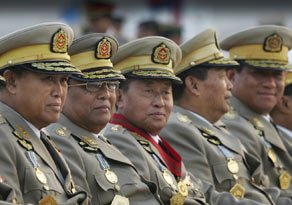
Members of Myanmar's ruling junta are shown during an Armed Forces Day ceremony

Members of Myanmar’s ruling junta are shown during an Armed Forces Day ceremony

The U.S. military’s (out of the Pacific Command) Cyclone Nargis humanitarian aid negotiations have provided a partial key in terms of strategy development vis.a.vis negotiating with General Than Shwe. That partial key (let’s call it Part 1 of 2) is that the tactic must not be perceived as “regime threatening.” Success with Myanmar will not come by the historic (but naïve) approach of rejecting Burma’s constitution and the sham referendum which ratified that constitution. That is “regime-threatening” and, as a negotiation strategy, it is a dead end. Similarly, insistence upon requiring General Than Shwe and his “State Peace and Democracy Council” (SPDC) release Daw Suu Kyi and some 2000 plus political prisoners, engage in a dialogue with Kyi’s political party, the “National League for Democracy” (NLD), is also regime-threatening and not going to achieve anything. Kyi’s trial will be a sham and Myanmar’s hopes for democracy will be put on ice a while longer. She cannot be forced into power at this juncture.

Once the “regime-threatening” Part 1 is understood and appreciated, a successful negotiation strategy emerges if it is combined with a Part 2 piece. Part 2 was interestingly delivered by Myanmar’s Prime Minister Thein Sein at the ASEAN summit in Thailand. There is a national election coming up in Myanmar in 2010. Prime Minister Sein has stated that Burma would allow the United Nations to monitor that election. So, Part 2 of the successful negotiating strategy is to set aside the “regime threatening,” and get ASEAN, Washington, and other concerned nations to hold the Burmese to their word. 2010 elections monitored by the United Nations. A strategy that bears a strong resemblance to the voter registration efforts in the Philippines of NAMFREL that ultimately unseated Ferdinand Marcos and brought Corazon Aquino to power in February of 1986.

There is more to Part 2 of the strategy, though. Kyi’s NLD must not be allowed to boycott the 2010 elections and simply cede the results back over to Than Shwe. The NLD must be encouraged to participate to the fullest extent possible.